
Renewable Energy Investment Beyond Wind and Solar: The New Infrastructure Plays Reshaping Power Markets
For a long time, the story of renewable energy investment sounded straightforward. Add more wind, add more solar, enjoy falling levelized costs, and let the grid figure out the rest. That narrative is starting to break. Power markets are running into congestion, curtailment, and volatility. Developers see negative prices in hours that should be profitable. Grid operators scramble to keep stability while politicians promise more electrification, more data centers, more EVs, and more heat pumps.
Capital has noticed. Global energy investment is projected to exceed 3 trillion dollars for the first time in 2024, with roughly 2 trillion directed to clean energy technologies and infrastructure, including renewables, grids, and storage. The opportunity set is no longer limited to turbines and panels. It now includes the infrastructure that sits around them and underneath them: long-duration storage, transmission corridors, distribution upgrades, flexible generation, hydrogen hubs, digital grid platforms, and microgrids.
For allocators, this is both attractive and uncomfortable. The underlying assets are often less familiar than a standard solar IPP. Revenue models look more complex than a 20-year PPA. Policy dependence is higher in some segments and subtler in others. Yet this is where a growing share of the energy transition value chain is forming. Investors who treat wind and solar as the whole game risk buying into markets that saturate while ignoring the assets that unlock the next phase of growth.
The question is not whether wind and solar will continue to attract capital. They will. The sharper question for institutional investors is how to position renewable energy investment strategies in a system that needs flexibility and infrastructure more than incremental megawatt hours at noon. That shift from projects to systems is where the new infrastructure plays live.
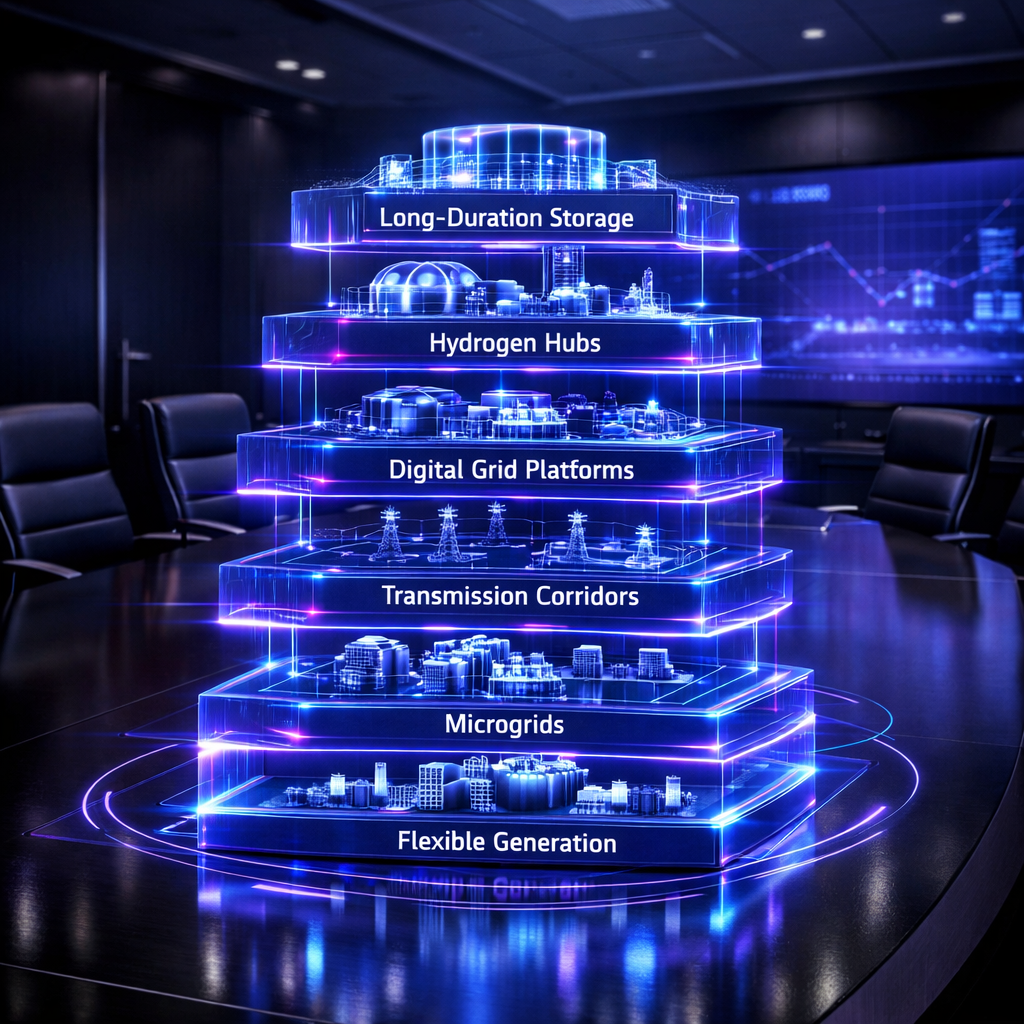
Renewable Energy Investment Beyond Wind and Solar: The Shift From Projects to Systems
The first generation of renewable deployment rewarded simple capacity addition. Subsidies and feed-in tariffs gave investors confidence that if they financed a wind farm or a solar park, revenue would follow. Integration was somebody else’s problem. That model has done its job. Now the limiting factor in many markets is not the cost of a solar module but the ability of the grid to absorb and move variable power.
World Energy Investment data shows that spending on renewable power, grids, and storage already exceeds total investment in oil, gas, and coal. BloombergNEF estimates that total energy transition investment across technologies passed 2 trillion dollars in 2024, with significant growth in energy storage, grid infrastructure, and electrified transport. The contours of the opportunity are shifting. The center of gravity is moving from pure generation assets to enabling infrastructure that makes high-renewables systems workable.
Investors who still organise their allocation frameworks around “wind versus solar” are operating with an outdated map. Power systems hitting 40 to 60 percent variable renewables do not only need more capacity. They need flexibility at multiple time scales. They need transmission that connects resource-rich regions to demand centers. They need distribution networks that can handle bidirectional flows, rooftop generation, and EV charging. They need data and control systems that make all of this visible and manageable.
This puts grid infrastructure at the heart of renewable energy investment strategy. The International Energy Agency estimates that annual grid investment must more than double from around 330 billion dollars per year to roughly 750 billion by 2030 to stay on track for net zero scenarios, with most of that directed to modernising and digitalising distribution networks. Grids are no longer a forgotten regulated asset in the background. They are the enabler, and in some markets the bottleneck.
Storage is the other anchor. Short-duration batteries are already standard in many solar projects. The next wave involves long-duration energy storage that can shift power across days and seasons, acting as a hedge against prolonged weather patterns and extreme events. National labs, multilateral agencies, and industry groups are converging on the view that long-duration systems will be central for balancing deeply decarbonised grids over the next decades. Investors are moving from pilot curiosity to platform thinking.
Once you start viewing renewables as a system rather than a set of assets, the investment universe broadens. Interconnectors that link regional power markets. Flexible demand infrastructure for large loads such as data centers or industrial clusters. Microgrids that integrate local solar, storage, and back-up generation into resilient “energy campuses.” None of these assets are wind or solar plants. All of them are required for high penetration of wind and solar to be economically viable.
This is the strategic inflection point. The first phase rewarded pure capacity builders. The next phase rewards investors who are willing to study power markets, grid codes, and regulatory regimes closely enough to finance the pipes, wires, storage tanks, and software that keep the system stable. That is where the more interesting risk-return profiles now sit.
Storage and Grids as Core Themes in Renewable Energy Investment
If you talk to grid operators in Europe, North America, or parts of Latin America, a pattern emerges quickly. The constraint is rarely “not enough renewables.” It is “not enough infrastructure to move and shape renewable output.” The IEA expects annual grid investment to climb toward 400 billion dollars in 2024, reversing a decade of stagnation. At the same time, energy storage deployments are rising sharply, with global installed capacity measured in tens of gigawatts and growing.
For investors, grids can feel like a different world from merchant solar. They are often regulated, capital intensive, and bound to long-term tariff frameworks. Yet that is exactly why they are attractive for some pools of capital. Grid assets can provide stable, inflation-linked returns with regulatory risk as the main variable. In jurisdictions with credible regulators and transparent tariff methodologies, that risk is quantifiable and manageable.
Within grids, the most interesting pockets of value often show up at the edges. Distribution utilities upgrading networks to handle rooftop solar and EV charging. Transmission developers building high voltage lines to connect offshore wind clusters to industrial regions. Grid digitalisation vendors providing advanced metering infrastructure, control software, and analytics. Equity and infrastructure debt can each find their place in this stack.
Storage sits at a different point on the risk spectrum. Short duration lithium-ion batteries that earn revenue from frequency response and peak shaving are now a known product in markets like the UK, Australia, and parts of the US. Revenue stacking is still complex, but the broad contours of the business model are visible. Long duration storage is earlier and more varied. Technologies include flow batteries, compressed air, pumped hydro refurbishment, and novel systems such as CO₂-based storage or thermal bricks.
The key for investors is discipline about where value actually comes from. Some storage projects rely mostly on capacity payments from system operators. Others depend on arbitrage between low and high price periods in wholesale markets. Some embed themselves inside industrial sites or data centers and monetise reliability and resilience rather than pure energy services. The mix of contracted versus merchant revenue will shape cost of capital and structuring options.
Three questions tend to separate thoughtful storage and grid investors from those chasing headlines:
- What precise system problem is this asset solving, and who is willing to pay for that solution over 10 to 20 years?
- How correlated is the revenue with broader power market volatility, and can that correlation be hedged or diversified?
- What decisions are still policy dependent, and how credible is the policymaker in this jurisdiction?
Investors who can answer these clearly can justify allocation to projects that look unfamiliar at first sight but line up well with long-term decarbonisation and electrification trends. Those who cannot answer them drift toward speculative bets that depend on optimistic price paths or unstable policy support.
There is also a portfolio construction angle. Many institutional allocators treat storage and grids as small satellites in an infrastructure portfolio dominated by more traditional assets. Given the direction of travel, that weighting will likely reverse over time in high-renewables systems. The question is how quickly investment policies and mandates will catch up.
Hydrogen, Geothermal, and New Fuels Expanding the Renewable Energy Investment Universe
Once grids and storage move into focus, the next layer in renewable energy investment is the set of technologies that convert renewable electricity into storable or dispatchable forms of energy. Hydrogen is the most talked about example, often for good reason and sometimes with too much hype. Geothermal, advanced bioenergy, and other new fuels sit beside it as less noisy but potentially powerful levers.
Green hydrogen, produced via electrolysis powered by renewable electricity, can decarbonise sectors that are hard to electrify directly, such as steel, chemicals, shipping, and parts of heavy transport. OECD work suggests that at least two-thirds of global hydrogen production could be green by mid century in net zero aligned scenarios. That projection is not a guarantee. It is a directional signal that large volumes of capital will be needed for electrolysers, dedicated renewables, storage caverns, pipelines, export terminals, and conversion plants for derivatives such as ammonia and methanol.
For investors, hydrogen projects sit at the intersection of energy, industrials, and trade infrastructure. The risk stack combines technology, offtake, policy, and cross border regulation. The most credible projects today tend to have three features. A clear anchor offtaker in a decarbonising industry cluster. Strong policy support in the form of contracts for difference, tax credits, or long term offtake backing from state entities. And a project structure that separates higher risk development equity from lower risk long term infrastructure equity and debt once offtake is contracted.
Geothermal is a quieter story but fits neatly into “beyond wind and solar.” Conventional hydrothermal resources have long supported reliable baseload power in markets like Iceland, Kenya, and parts of the US. The more interesting development for investors is enhanced geothermal systems that target heat at greater depth in geologies that were previously uneconomic to exploit. If drilling and stimulation techniques borrowed from oil and gas can be applied at scale, geothermal could provide firm low carbon power in markets that currently depend on gas or coal for reliability.
From a capital perspective, geothermal looks like a hybrid between upstream energy and power generation. Exploration risk is concentrated early. Once a resource is proven and a plant built, the asset can behave like a long life infrastructure project. That split creates room for specialised risk capital at the front end and more traditional infrastructure investors later, provided permitting and community issues are well managed.
Bioenergy also deserves a more nuanced view than it often receives. Not every bioenergy project is sustainable or attractive. However, there are segments that align well with a system-focused renewable energy investment thesis. Examples include waste to energy plants with strict emissions control, advanced biofuels from residues rather than purpose grown crops, and co-firing of sustainable biomass in plants that provide grid stability services. The value is not only in the electrons or molecules. It is in avoided landfill, local industrial integration, and the ability to provide dispatchable capacity when wind and solar sag.
Power-to-X projects that convert renewable electricity into synthetic fuels or feedstocks are even earlier but worth watching. These sit at the experimental end of the spectrum today. They may, over time, reshape maritime fuels, aviation, and chemical supply chains. For now, investors should treat them as innovation bets or small slices of diversified transition funds, not core allocation.
What unites hydrogen, geothermal, and new fuels is that they treat renewables as inputs into broader energy and industrial systems, not as standalone outputs. That is exactly the mindset shift sophisticated investors need. The return does not come from megawatt hours alone. It comes from solving system bottlenecks that others cannot easily address.
Underwriting Risk and Return in Next-Generation Renewable Energy Investment
If the opportunity set is widening, the underwriting challenge is sharpening. It is relatively easy to explain a contracted solar project with a stable PPA, low operating costs, and straightforward technology. It is harder to walk an investment committee through a long duration storage asset with a mix of merchant and contracted revenues, or an early stage hydrogen hub that depends on three different policy frameworks and industrial offtake.
The right response is not to retreat to familiarity. It is to upgrade how risk is framed, priced, and mitigated. That begins with clarity on revenue design. In many of these new infrastructure plays, the difference between an institutional grade asset and a speculative one is simply the share of revenue anchored in long term contracts versus short term market exposure. Investors can insist on minimum contracted revenue floors, revenue sharing with offtakers, or regulatory mechanisms that top up income when market prices collapse.
Regulatory and policy risk needs to move from footnotes into the core of the investment thesis. Grid tariffs, capacity market rules, ancillary services payment structures, and hydrogen incentive schemes all shape cash flows directly. Investors should map out explicit policy scenarios and stress test DSCR, IRR, and payback under each. That is not an academic exercise. It is a way to avoid surprises when a regulator updates rules or a subsidy regime is revised.
Technology risk is another area where habits must evolve. For storage, questions about cycle life, degradation, and supply chain resilience are just as important as capex per kilowatt hour. For hydrogen, electrolyser efficiency, stack lifetime, and balance of plant costs matter as much as headline production capacity. For geothermal, drilling success rates and reservoir performance are the core. Investors who lack internal technical depth will either need to partner with specialists or stay in more mature segments of the value chain.
There is also a portfolio lens. Allocators can balance early stage, higher risk exposures in emerging technologies with more conservative positions in regulated grid assets or contracted storage. They can use fund of funds or specialist managers for experimental themes, while keeping direct mandates for grids, batteries, and proven low carbon generation. The goal is not to avoid risk. The goal is to make sure each unit of risk has a clear, rational return attached.
Finally, governance and transparency matter more as the system grows more complex. Boards and LPs will want to know not just what their exposure to “renewables” is, but how much is in merchant markets, how much depends on single policy instruments, and how much sits in technologies with limited operating track record. Managers who can answer those questions precisely will have an easier time raising capital for the next wave of renewable energy investment.
Renewables are no longer just about building more wind farms and solar parks. The real action now sits in the infrastructure that connects, stabilises, and deepens the role of clean power in modern economies. Storage, grids, hydrogen hubs, geothermal projects, and new fuel value chains are turning into investable themes rather than side notes. For investors, that shift demands more homework, more technical fluency, and a sharper feel for power markets and policy. The payoff is access to assets that sit at the heart of future power systems rather than at the edges. Treat renewable energy investment as a system problem, not a project problem, and the next decade of opportunities starts to come into focus.